


Compuestos de goma y empleos
La versión española de esta página está en desarrollo. Favor de disculparnos de cualquier molestia. Se muestra la versión inglesa a continuación:
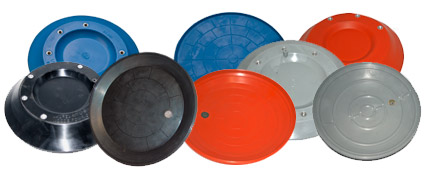
Most vacuum pads are available in various rubber compounds for different applications.
Please contact us or your authorized dealer for help selecting the best rubber for you.
↓ Rubber Compounds Comparison Chart
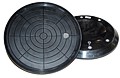 Standard
 |
1) Standard rubber is our most widely used compound, with superior performance in a variety of environments. This compound also features excellent abrasion resistance. (Not recommended for contact with oily surfaces.) |
 Low-Marking
 |
2) Low-marking rubber avoids leaving marks or stains on light-colored materials. This low-marking compound is recommended for indoor applications, such as production lines (see low-marking/UV-resistant compound for outdoor use). This compound also excels in resisting abrasion. |
 Oil-Resistant
 |
3) Oil-resistant rubber resists damage from petroleum-based oils, like those commonly found on sheet and plate metals. This compound also features superior abrasion resistance. |
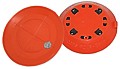 Heat-Resistant
 |
4) Heat-resistant rubber is ideal for removing glass from tempering ovens. However, they have about half the lifting capacity compared to standard rubber. |
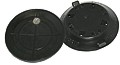 UV-Resistant
 |
5) UV-resistant rubber is ideal for extended use outdoors.Commonly used on windshields or in similar outdoor settings. |
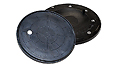 Medium-Flexible
 |
6) Standard medium-flexible rubber provides flexibility, allowing vacuum pads to attach to textured surfaces, such as pattern glass. |
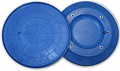 Coating-Compatible
 |
7) Coating-compatible rubber is designed to handle low-E glass and other coated materials without leaving markings. It's also good for handling painted and silk-screened glass. |
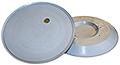 Low-Marking,
UV-Resistant |
8) Low-marking/UV-resistant rubber avoids leaving marks and also stands up to extended outdoor use. Ideal for light colored materials. |
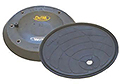 Low-Marking,
Medium-Flexible |
9) Low-marking/medium flexible rubber avoids leaving marks on lighter materials, while also providing flexibility, allowing vacuum pads to attach to textured surfaces, such as pattern glass, as well as thin materials. |
Comparison Chart of Rubber Compounds
| Rubber compounds | Resist load slippage (Friction coefficient) | Resist staining load | Resist marking load | Resist damage from oil | Resist damage from heat (Max surface temp) | Resist UV damage (Average outdoor service life) | Resist damage from abrasion | Attach to textured surfaces | Avoid damaging coated surfaces |
|---|---|---|---|---|---|---|---|---|---|
| 1) Standard | Excellent (1.0) | Good | Good | Poor | Fair (150°F) | Good (2 years) | Excellent | Good | Poor |
| 2) Low-Marking | Good (0.75) | Excellent | Excellent | Poor | Fair (150°F) | Poor | Excellent | Good | Poor |
| 3) Oil-Resistant | Excellent (1.0) | Good | Good | Excellent | Fair (150°F) | Fair (1 year) | Excellent | Poor | Poor |
| 4) Heat-Resistant | Fair (0.45) | Good | Good | Poor | Excellent (400°F) | Excellent (8 years) | Good | Poor | Poor |
| 5) UV-Resistant | Good (0.75) | Good | Poor | Good | Good (225°F) | Good (4 years) | Good | Good | Poor |
| 6)Standard Medium-Flexible | Excellent (1.0) | Good | Good | Poor | Fair (150°F) | Good (2 years) | Excellent | Excellent | Poor |
| 7) Coating-Compatible | Excellent (1.0) | Excellent | Good | Excellent | Fair (150°F) | Excellent (8 years) | Excellent | Good | Excellent |
| 8) Low-Marking & UV-Resistant | Good (0.8) | Excellent | Excellent | Good | Good (225°F) | Good (4 years) | Good | Good | Poor |
| 9) Low-Marking & Medium-Flexible | Good (0.75) | Excellent | Excellent | Poor | Fair (150°F) | Fair (0.5 years) | Excellent | Good | Poor |